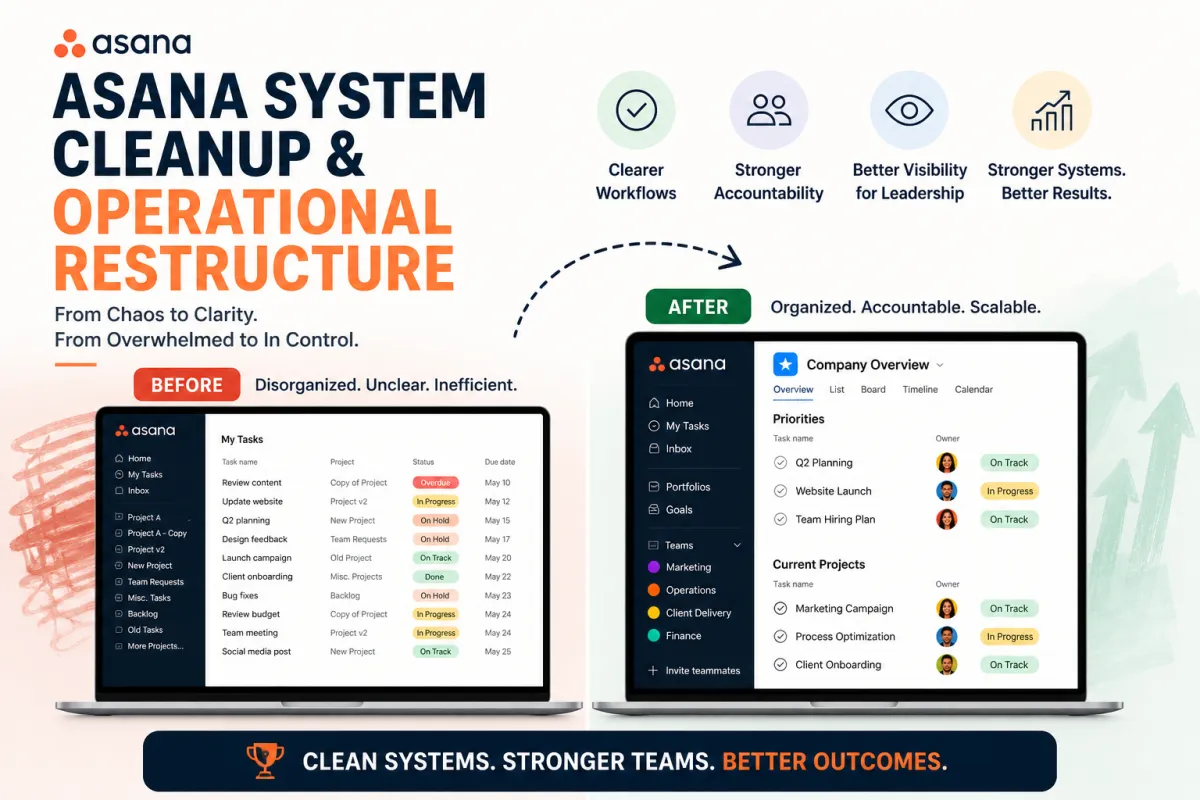
Asana System Cleanup & Operational Restructure
Turning a “working” system into one the team actually trusts
Most teams don’t come to me because Asana is broken.
They come to me because it technically works… but everything around it feels off.
Things slip.
People follow up constantly.
Leadership doesn’t fully trust what they’re seeing.
That was exactly the case here.
The Problem: A System That Looked Fine… But Wasn’t
On the surface, this team had a functioning Asana setup.
Projects existed. Tasks were getting created. Work was moving.
But underneath that, there were real operational issues:
Tasks were getting lost or completed late
Duplicate and unnecessary projects created confusion
Ownership wasn’t clear across teams
Leadership had no reliable visibility into what was actually happening
So while the system “worked,” it was creating more friction than it solved.
What Was Actually Breaking
This wasn’t a tool problem—it was a structure problem.
The setup had evolved over time without a clear strategy behind it. Teams built their own ways of working, which led to:
Inconsistent workflows
Multiple places tracking the same work
Lack of standardization across projects
No clear source of truth
The result?
👉 More manual follow-up
👉 Slower execution
👉 Lower trust in the system
The Approach: Rebuild Around How the Business Operates
Instead of patching what was there, I rebuilt the system with one goal:
Make Asana reflect how the business actually works—not how it accidentally evolved.
Here’s what that looked like:
1. Rebuilt the Project Structure
Projects were restructured to align with real workflows and team responsibilities—not just departments or one-off needs.
2. Standardized Workflows Across Teams
Every team now operates with consistent stages, expectations, and movement of work.
No more guessing. No more reinventing the wheel.
3. Removed Complexity & Duplicate Tracking
We eliminated unnecessary projects, duplicate tasks, and overlapping systems.
Everything now has a clear home.
4. Implemented Clear Ownership & Status Tracking
Every task has:
a clear owner
a clear status
a clear next step
Which means no more “who’s responsible for this?” moments.
The Outcome: A System That Actually Works
This wasn’t about making Asana look cleaner.
It was about making the business run better.
Here’s what changed:
Missed work and delays were significantly reduced
Manual follow-up dropped across teams
Accountability increased because ownership was clear
Leadership finally had visibility they could trust
Final Thought
If your team is constantly:
following up
double-checking work
questioning what’s actually done
…it’s not a people problem.
It’s a system problem.
And fixing it doesn’t require more discipline—it requires the right structure.